Practical bilingual reading
How to Read English Books With Vietnamese Translation Without Stopping Every Page
A practical bilingual reading method for English learners who want Vietnamese support nearby without turning every chapter into a lookup exercise.
Read the English first, even when Vietnamese is nearby
A bilingual book is most helpful when it keeps you moving through the original, not when it turns into a Vietnamese book with occasional English decoration. Start each paragraph in English. Give yourself a moment to understand the action, tone, or argument before looking down.
Then use Vietnamese for the part that blocked you: an idiom, a long sentence, a reference you missed, or a word whose meaning changes in context. This makes translation a tool for recovering momentum rather than a shortcut that replaces reading.
Keep translation close enough to be useful
Switching between an English ebook and a separate translated file is where many reading plans fall apart. You lose your place, search for the matching paragraph, and begin reading only the translation. A bilingual EPUB or PDF removes that friction by placing help near the source passage.
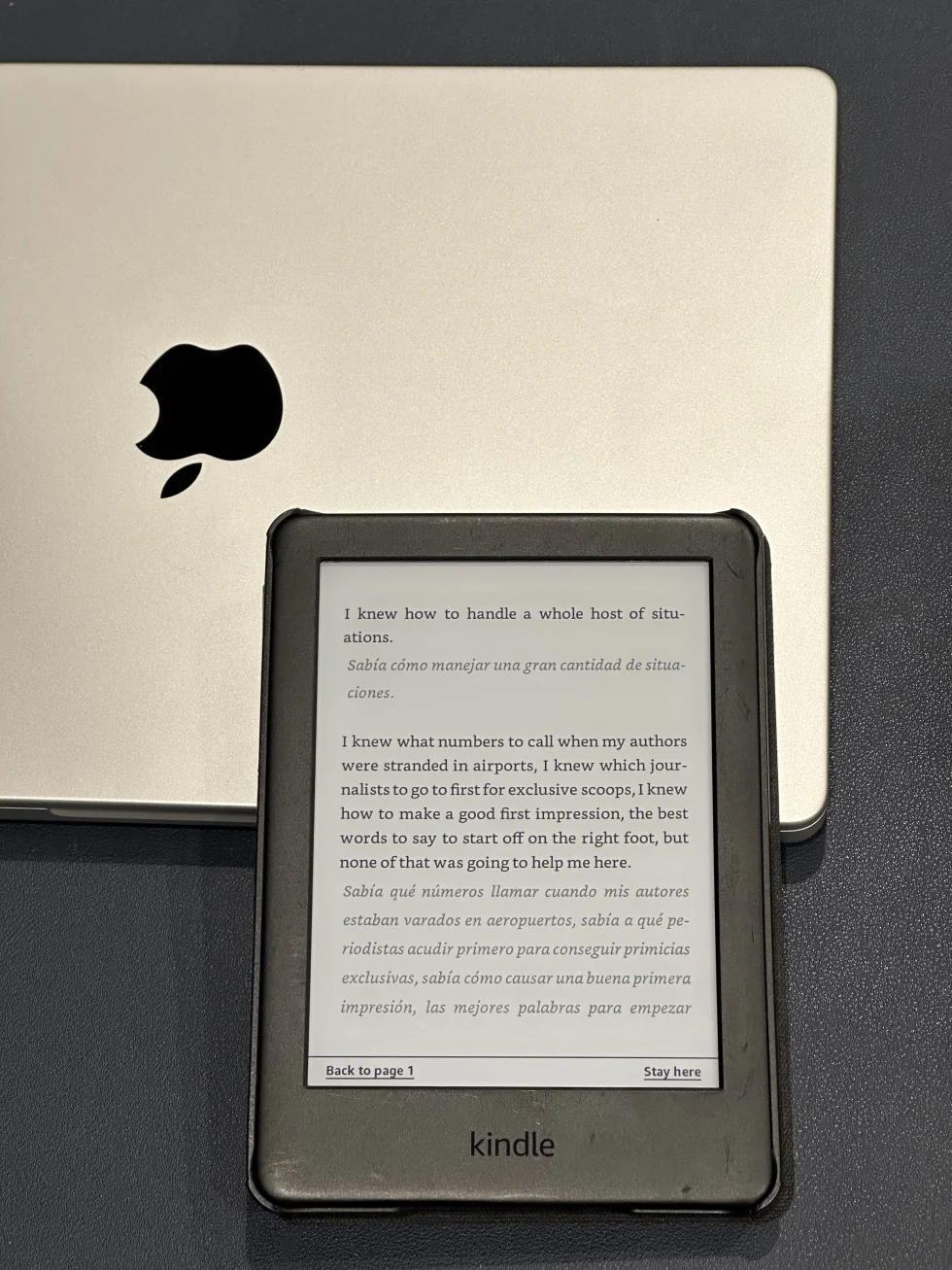
The device image uses English and Spanish, but the reading behaviour is the same for English and Vietnamese: a source block is followed by its translation inside one continuous book. The scripts change; the advantage of not leaving the page does not.
Choose difficulty that still leaves room for enjoyment
If every sentence needs translation, the book may be too difficult for extensive reading right now. Use shorter sections, choose a familiar story, or read with more support until the English feels less dense. That is not failure; it is choosing material that can build momentum.
Notice patterns rather than counting every unknown word. If the same phrase or grammar pattern slows you repeatedly, mark it. If a rare word appears once and does not affect the scene, let it go. A novel should not become a vocabulary spreadsheet.
Build a small routine
Read ten to twenty minutes at a time. Underline only a few phrases worth returning to. At the end of a chapter, describe what happened without looking. The aim is to connect meaning, not to memorise every translation pair.
For a legal or academic document rather than a novel, the same local-comparison principle applies, but PDF may be better. For book-length reading on an e-reader, a bilingual EPUB is usually the calmer option.
How to avoid turning every chapter into translation practice
Set a limit before you start: perhaps check three genuinely confusing passages per page, then keep moving. A limit protects the story from becoming a series of interruptions and gives you a reason to tolerate a little uncertainty, which is part of learning to read in another language.
When you do check a translation, look back at the English one more time before you continue. Notice one useful detail: a connector, verb tense, phrasal verb, or turn of phrase. That single second is what turns passive reassurance into a small piece of reading practice.
It also helps to choose a book whose plot you want to know. Curiosity is a better engine than discipline alone. Familiar genres, short chapters, and an author you already enjoy in Vietnamese can make English feel challenging without making every page feel like homework.
If you find yourself reading only Vietnamese for several pages, pause rather than pushing through. Reduce the session length, increase the font size, or choose an easier chapter. The goal is a sustainable relationship with the English text, not an impressive-looking daily word count.